Hello and welcome to My Review! This is a series of reviews for games I’ve read or played. This is simply my opinion, and your experience may vary wildly depending on your table. I hope this helps you figure out if this system is for you.
Background
Publisher: Free League Publishing [DTRPG, Free League]
Publish Date: 2015
My Experience: My wife and I have been playing Symbaroum for around 10 sessions using the Mythic Game Master Emulator. We’ve got around 100 XP and have gone through The Wrath of the Warden published campaign, and at time of writing are starting on The Witch Hammer.
This is part 2 of my discussion on Symbaroum, a system I (spoilers) rather enjoy. For part one go see the Let’s Learn: Symbaroum to understand how the game system plays.
This review is split into 3 sections:
- My Thoughts: This section goes into my review, with pros/cons.
- Is Symbaroum for you?: Depending on your tastes, the game may be better or worse for you. This section describes some tradeoffs.
- What do I buy?: This gives my personal take on what to buy.
My Thoughts
Symbaroum lives and dies on whether you and your table will take to it’s approach to a dark fantasy world. While you don’t need to play in the setting provided, it’s pretty hard to separate it from the abilities and mechanics. As a person who finds herself constantly homebrewing settings, this was initially a turn off. However, the more I read about the setting the more it’s clearly a sandbox of factions and a looming challenge in the form of the forest. It really intrigued me and honestly the more I read about it the more I enjoy it’s worldbuilding.

The game system is simultaneously a selling point and a huge detractor depending on who you talk to. There’s a fairly active subreddit and discord server, and there’s constant chatter about the game’s ‘imbalance.’ While I don’t really buy into mechanical balance as a core feature of a TTRPG, players do gain power pretty quickly, and there’s a definite ‘optimized’ path one can take. I’ll say that in my experience this is definitely true, but also the monsters really can do some terrifying things to players that can end them pretty fast. This does require the GM to understand their players and to use their monsters tactically, and to not be afraid to throw one too many threats at them. Players should feel like running away is a good option, as some threats they cannot kill.
Overall this comes to my main point: this game has an OSR feel to it. OSR, for those that are unaware stands for “Old School Renaissance.” It’s a revival of the stripped down ruleset of old D&D before 3.5 made things all rulesy. OSR has a focus on ‘rulings not rules’ or calls made by the GM at the table as opposed to a system that tells you how to adjudicate every possible situation. These systems are typically stripped down to their basics, lacking rules for many situations.
Symbaroum has OSR leanings in that it is more focused on rulings than rules. There are no rules in this system for social interactions, but there are rules for factional play. There are no hard and fast rules for travel, but there are suggestions on how to make it hard. It’s a game that thrives on the GM knowing when to turn the screws and when to let off. If the party is at 1 toughness each, filled with corruption… maybe don’t generate an encounter tonight. Allow them a peaceful night in Davokar to rest and recover. This ethos won’t be for everyone, but it is great for me and my table.
Pros
- Relatively rules light: the mechanics are fairly light and intuitive.
- Abstract Movement: I really like how simple, yet tactical movement feels without a grid. It still has a lot of what makes tactical games great, but without feeling bogged down in the rules.
- Corruption: The VIBE of corruption is excellent, and at lower levels it really makes magic feel dangerous. You’re just one bad roll away from becoming forever blighted.
- Distinct Characters: The Abilities system allows for some truly interesting and unique combos that make players feel smart.
- Worldbuilding: I love the strange, dark fantasy world of Symbaroum. It’s a fresh take on this genre and is filled with some incredibly compelling world building. While all factions at surface level appear very one note, each is made up of complex factions. For example: the catholic church analog (with inquisition in full swing) has a Lutheran analog who wants to change the sun religion from the ‘law giver’ to the ‘life giver’ .
Cons
- Modifiers: This part of system is annoying at first. It’s sometimes hard to remember all your bonuses from your weapon, enemy armor, and situational advantages.
- Few out of Combat abilities: There are only around 6 out of combat Abilities, which does funnel people toward murder. That said, almost all published adventures expect someone in the party to have Beast Lore and/or Loremaster. These become critical abilities, but are really undersold by everything being so murder focused.
- Rule gaps: Given how much of this game is about traveling through a dark forest, there’s not much guidance for it in the core rulebook (it’s in the GM Guide, but that kinda irks me).
- GM finesse: The game forces characters to become walking murder machines, and the GM has to adapt. It makes a very 5e-esque challenge for the DM to properly balance things to challenge players without killing them.
To Taste
These are things that are neither pro, nor con.
- GM Doesn’t roll: this is always a strange one. It works decently well in the system, but is just not always my taste.
- Broken characters: A criticism of the system is how broken characters can become. This is a very fair assessment, and requires a GM to be on their toes when building and balancing encounters. That said, it’s not so hard to throw a frightening array of baddies at the players that can challenge them, the action economy is real.
- Incremental Growth: This system has no levels, and the 1 XP per scene thing really leans on some (to me) annoying accounting on the part of the GM. Plus, given that XP is given at the end of an adventure, players will be waiting some time for their upgrades.
Is Symbaroum for you?
So that’s my take. Personally, it’s the setting that truly sold me on Symbaroum, but you’ll need to buy the book to understand what I’m talking about. That said, it’s worth calling out that the rules require some buy-in from the table.
As I mentioned earlier, system gives almost no guidance on social encounters, the core rules providing only this snippet:
It is inappropriate to solve important negotiations by making a couple of Persuasive tests; it will feel more rewarding if the players roleplay their way through such encounters.
Symbaroum: Core Rulebook by Free League Publishing
I wholeheartedly agree with this, and in that way this game shows off its more OSR style rules. OSR games aren’t going to ask you to roll to persuade the guard; instead, make an argument and if the GM thinks it’s a good one, it persuades the guard. I love this, it makes the game more rulings than rules, but some tables want more mechanics. This does make the system a bit less approachable to brand new GMs, but your milage may vary.
Second, the world is threatening and deadly… but the game allows players to build some truly broken builds. It is worth calling out that Symbaroum is not a system of attrition like D&D: with the exception of HP (toughness) almost all their abilities come back after a fight. This means that PCs are always ready for a fight, but fights are dangerous, corrupting affairs. This means each encounter can be (largely) thought of fighting the PCs at full health, no ‘adventuring day’ from D&D. Any attrition will simply be from their supplies of potions and food.
The counter balance is that the strongest builds often the stuff that is the most evil or shunned by society (lookin at you sorcerers and rage trolls). It requires a GM that enforces the setting (and ability requirements) and is willing to put in the extra time to build a challenging encounter for the players. This requires some system mastery from the GM, which you will gain with time.
Overall, I find it a blast of a system with fairly lightweight rules with some deep character options. Plus, I cannot gush enough about its setting and presentation. I’ll add that the adventures are very good, though a bit wordy.
What do I buy?
Buy the books: [DTRPG, Free League]
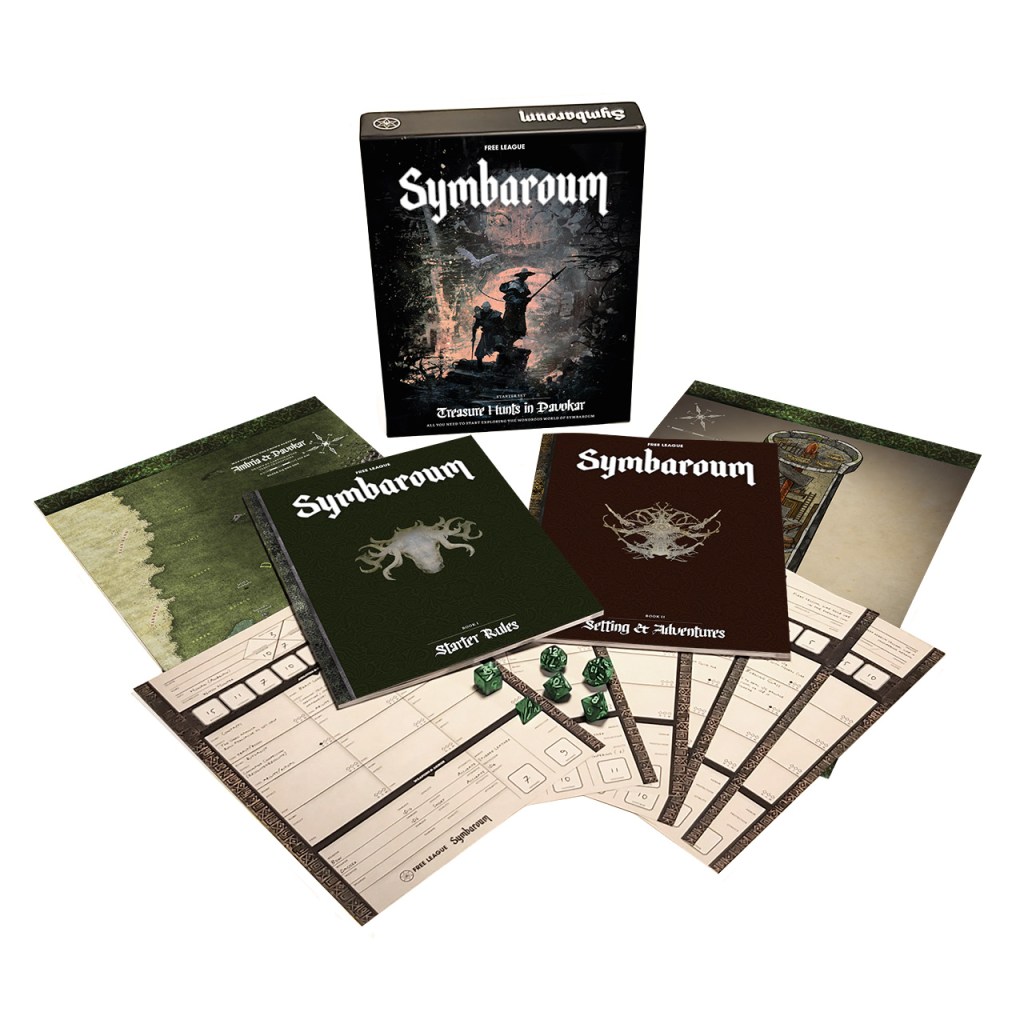
If you’re convinced, let’s talk money. Symbaroum is a game that’s been around for many years, so it has a lot of books. You only truly need the core rulebook to play, but I advise a few additional purchases on top of that:
- Advanced Player’s Guide – This one vastly expands the player’s options and adds in several new weapons and armor types. It’s where some of the scariest player builds come from, but honestly that’s where the fun is. My advice: buy it, it adds more options for a table that wants those.
- Monster Codex – Honestly, these are some rad creatures regardless of system, and if you’re struggling to scare your players then open up this bad boy and there’s some truly frightening challenges in here. My Advice: buy it, the vibe and monsters are cool regardless of system.
- Adventure Collection – while this was my first introduction to Symbaroum, it only has 2 low level adventures (which are both solid) plus a bunch that come interspersed between the throne of thorns storyline. My Advice: Not critical, but if you’re lacking adventure ideas, pick it up.
- GM Guide – internalizing this book really gives you a good grasp of encounter design, factional play, and travel rules. All of these are optional rules that you may not need until after you’ve run a few sessions. My advice: buy it only after a few sessions, if you like the game.
- Throne of Thorns Campaign (1-6) – this is a long adventure path that takes characters from roughly 100 XP to 450 XP (think of that like levels 1-20). The story is great, but the first campaign requires that players walk in with 100 XP (roughly 1 big adventure or a handful of tiny ones). My advice: try some of the smaller adventures first before diving into these.
A note here: While I have only played base Symbaroum, in 2022 Free League released a 5e conversion called ‘Ruins of Symbaroum’. If your table plays that, it’s likely an easy sell. My table has stopped 5e for some time, but if that’s your vibe, go for it! Just be aware since DTRPG tends to list them together in the same product line, which led me to buying the wrong player guide.
 The Witch's Wandering Table
Leave a comment