What is Cypher?
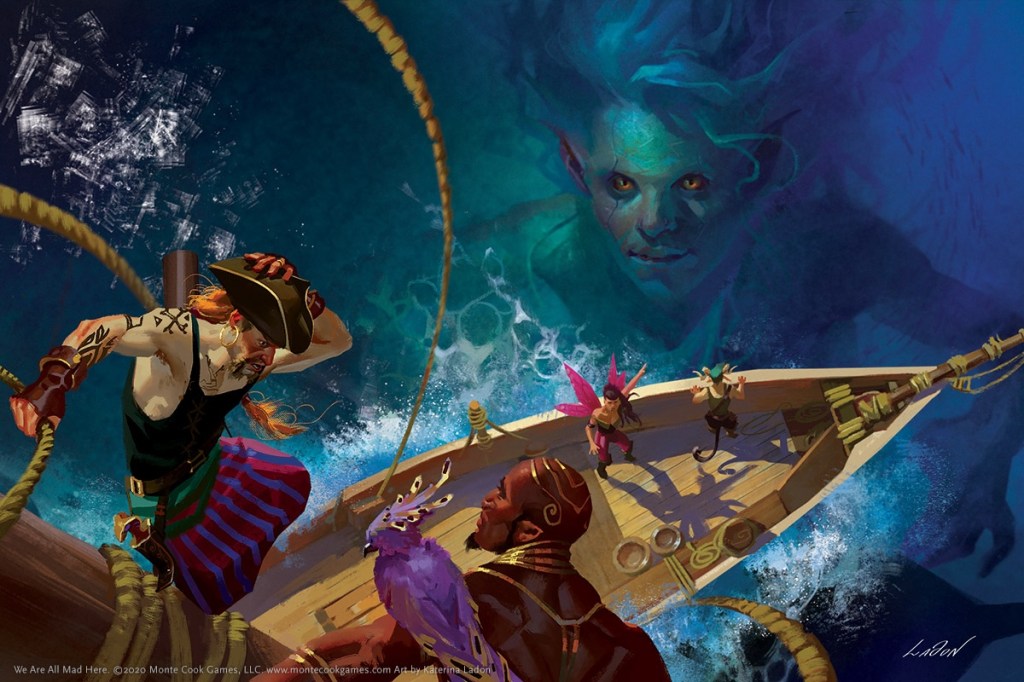
The Cypher system is a generic TTRPG system created by Monte Cook Games. It was spun off their Numenera setting into its own book in 2015 and updated in 2019. The game is a relatively lightweight d20 roll-high system. Where the game differentiates itself mechanically is that the GM doesn’t roll, instead they tell players on a scale of 1-10 how hard a task is. Players don’t add any modifiers to their roll, instead they spend points of health/speed/intellect to reduce the level of difficulty. The game tends toward strange settings where the players can constantly pick up small, random, one use items called Cyphers.
Setting
Being a generic system, Cypher has no specific genre attached to it. That said, Cypher comes from the Numenera setting.
Numenera is a strange world set in a pseudo-medieval setting 3 billion years in the future. Technology and magic are indistinguishable, and everything is extremely strange. Characters dive into ancient ruins and gather artifacts and cyphers, managing their various point pools along the way. In that way it’s very similar to a classic dungeon crawler, just with the setting filed off. While it can do anything, it’s certainly best at doing something that looks like a dungeon crawl/hexcrawl when you squint at it.
How do you play?
Before we get into how to roll any dice, let’s understand the basics of characters so this makes any amount of sense.
Character Stats
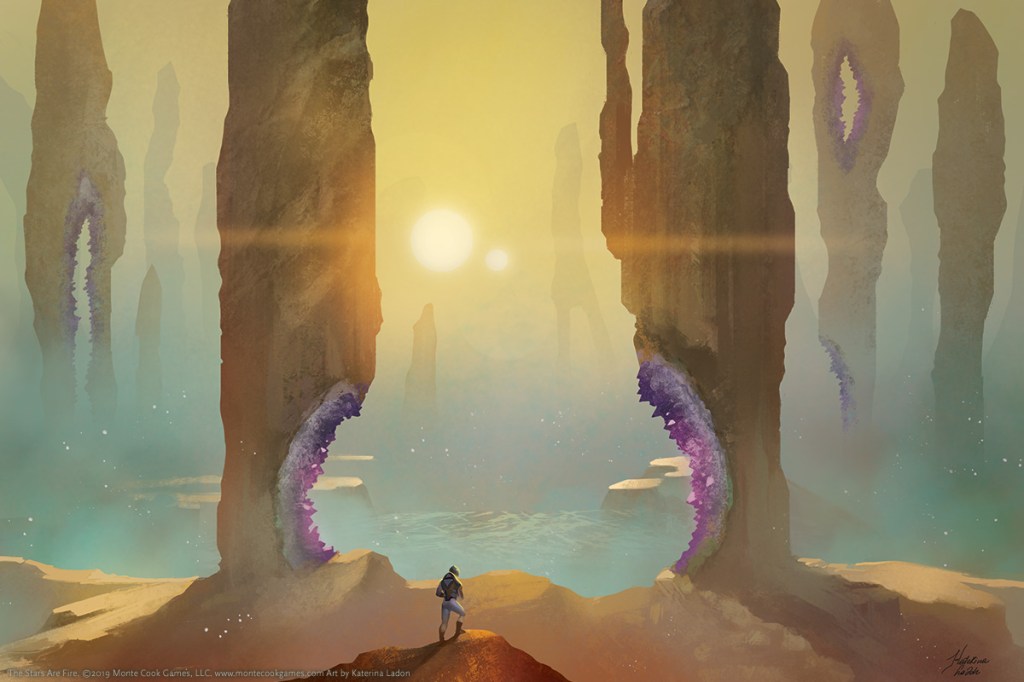
Characters in cypher have 3 stats: might, speed, and intellect. Might represents the characters strength and constitution, speed is their nimbleness and dexterity, and intellect is their intelligence and charisma. These stats are actually a pool of points the characters can spend on various things such as
- Activate abilities: Some abilities cost several points from one of the PC’s pools to activate.
- Absorb damage: If the character takes damage, their pool absorbs it. Typically, damage hits your might pool first, then speed, and finally intellect.
- Lower the difficulty of a task: See ‘Rolling’ below.
Each pool starts at roughly 11 points (though different classes distribute that differently).
Skills
Besides stats, characters can gain training in skills. Neither Cypher nor Numenera has a hard and fast skill list; they provide a suggested list but leave it up to the GM to determine how specific they want their skills. Characters can get a training in a skill, and if they take that training again, they gain specialization in that skill. Skills make tasks easier by 1 level, and if the character is specialized in that skill, it reduces the difficulty by 2 levels.
Assets
Assets are equipment, circumstances of the scene, or things found in the scene. They make tasks easier and are very much up to the discretion of the GM whether they apply.
Rolling
Rolling dice differs from in most d20 systems. Primarily, GMs don’t roll. They instead set a difficulty from 1 to 10 and select one of the 3 stats for the current situation. Most checks will be called out in the form “level 3 intellect”. Players roll a d20 and must roll equal to or higher than 3×Difficulty Level. Ex. A difficulty level of 3 means players must roll at or over 9 to succeed.
Effort
You’ll notice that a difficulty of 7 means you must get a 21 on a d20… which is impossible. To make that possible, players can ‘use effort’ (aka spend points from their pool) to lower the level of difficulty. These points must come from the pool the GM selected earlier (i.e. “level 3 intellect” would mean you can only spend points from your intellect pool). The cost in points is 3 for lowering it by 1, and 2 additional points for each level of lowering after that. Each reduction is called a ‘level of effort.’
Character advancement caps effort, so tier 1 characters can only do 1 level of effort.
Edge
Because this can become really costly really quickly, players gain an ‘edge’ which reduces the cost of a specific pool expenditure. That means players may have a ‘speed edge of 1’ which means any time they spend points out of their speed pool, reducing the cost by 1. The neat thing is, this can reduce costs all the way to 0. This doesn’t apply to taking damage in that pool, that is reduced by armor.
It’s also important to note that for every action, edge only reduces the total cost – that is the sum of the ability activation and effort. So if you activate an ability to shoot a fireball (costing 1 intellect) and choose to reduce the difficulty by using effort (say 1 level of effort, so 3), the total cost is the ability activation plus the effort is 4 intellect. An intellect edge would reduce that to 3 intellect.
Assets & Skills
Assets and skills can also reduce the difficulty of a roll, each by at most 2 steps. This means that assets and skills can never reduce the difficulty by more than 4. The GM decides what applies, but often it’s a conversation with the player whether a specific skill applies to a specific roll.
Example
Mira’s character Inara is trying to break into a secure warehouse. The GM rules that this is a speed task with a difficulty level of 5. That means Mira would have to roll a 15 (5×3) or higher to succeed. Inara is trained in the skill of stealth, which the GM rules reduces the difficulty by 1 step to 4. She also stole a guard’s outfit, which the GM rules is an asset that reduces the difficulty one more step. All told, she has reduced the difficulty to a 3, she only needs a 9 (3×3) or higher. Still not liking those odds, Mira spends some points out of Inara’s speed pool to reduce the difficulty. She decides she wants to reduce the difficulty by spending 2 levels of effort, bringing the number she has to roll to a 3 (1×3). This will cost her 5 points: 3 points to reduce it by 1 level, and an additional 2 to reduce it again. Thanks to her speed edge of 2, this reduces that 5 point expenditure to only 3 points. She rolls and gets a 6, which is a success! Good thing she reduced the difficulty!
Crits
Just like many d20 based systems, Cypher allows players to have critical effects at high and low rolls.
A natural 17-20 has a variety of useful effects, including dealing more damage or having a major/minor effect. These effects cover many of the standard ‘special attacks’ in D&D: knock back, knock prone, disarm, etc. You can pre-select these effects, but it subtracts from your d20 result.
A natural 1 is a free GM intrusion (see below). The GM makes things bad for you, and you don’t get to do anything about it.
Building a Character
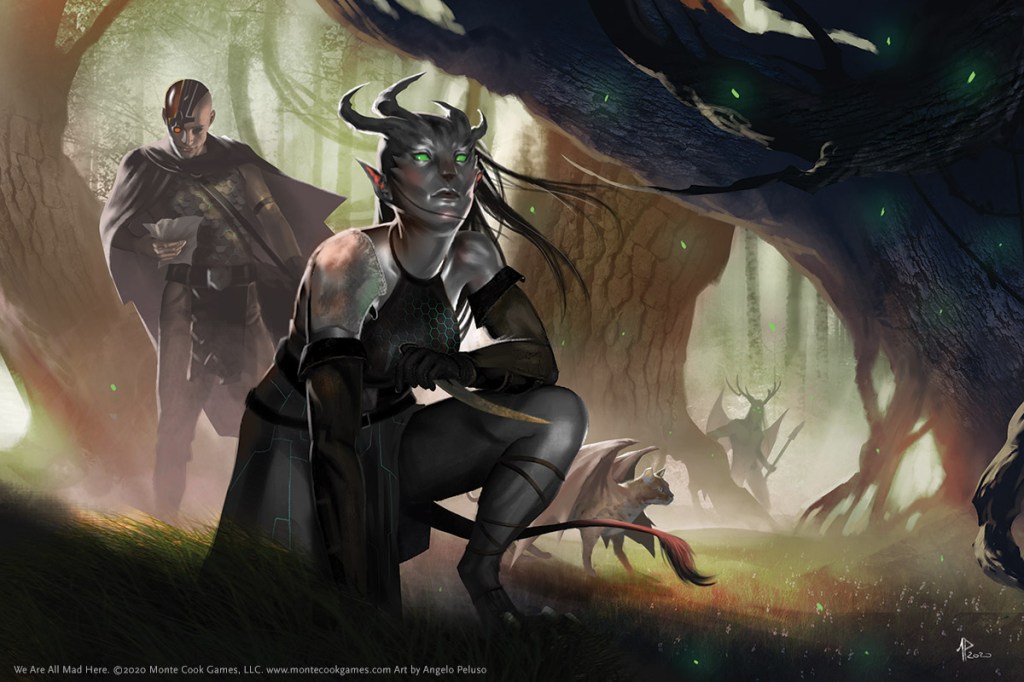
Character creation in cypher is often called simple as characters are described using a simple phrase: “I am a (adjective) (noun) who (verbs).” I find this gimmicky as it’s wordier than ‘human fighter’ and there’s still a fair amount of effort to creating your character… but let’s dive in.
In the phrase, each component is a part of your character creation:
- Type: This is the noun, and is your character’s class this is Warrior, Adept, Explorer, Speaker. These are basically classes of the fight-y, magic-y, skill-y, and talk-y variety, respectively.
- Flavor: This alters your type and there are 5 of these: stealth, technology, magic, combat, and skills & knowledge. You can replace abilities you have in your type with the ones found in the flavor, making these a lot like a subclass. This allows you to make a sneaky explorer (a rogue) or a technology adept (artificer).
- Descriptor: This is the adjective and is a measure of your character’s personality or aptitude. Something like ‘fast’ ‘appealing’ or ‘crafty’ there’s a long list of descriptors that all have unique effects on the character, typically on their skills or pool sizes.
- Focus: This is your verb. It makes your character unique and adds a lot of the best abilities in the game. So a focus of ‘crafts illusions’ will grant you the ability to make illusions, regardless of whether you’re an adept.
All descriptors, focuses, flavors, and types are freely available, so you almost always make a very customized character. Each option offers you a choice of skills, extra points to pools and special abilities which can do anything from give you more of the same (skills, points) or cool powers like the ability to hurl lightning. Plus all of them level up with you (see advancement below). Character creation is no more difficult than in something like 5e, and you always end up with something personalized to you.
Example
Mira is building her character Inara. She’s selected the ‘explorer’ type, but wants a character that’s more a ‘secret agent who can lie her way into any situation’ so she adds ‘stealth flavor,’ adding some abilities for her to choose from. She then decides that the descriptor ‘clever’ fits her image of a smart roguish type. Finally, she selects a focus of ‘crafts illusions’ as she’s imagining her rogue has access to a handful of useful magical tricks to blend in. This means her character’s statement is: “I am a clever stealthy explorer who crafts illusions.”
XP
PCs gain experience points through play, either from one time rewards from the GM or from ‘GM Intrusions’ (see below). The one time rewards cover a reasonable variety of events, such as finding an artifact, discovering something new, or pursuing a character arc. It’s up to the GM to award these, but between all the different sources of XP, characters should gain 2-4 XP per session.
Interestingly, unlike other systems XP is simultaneously a currency for character advancement and a meta-currency to allow for the Player to trigger neat effects. These effects depend on how much XP the character can or will spend, for example:
- 1XP = re-roll a die, that can be yours or another players.
- 2XP = allows for a short-term tweak to your character. Players who spend 2 XP can simply say ‘I’ve been through these woods before’ to gain a skill in navigating them. This is true while in this area, but does not apply to other wooded areas.
- 3XP = allows for a long-term benefit. This could be a friendly contact that can help the PCs with information, equipment, or tasks. They’re a long-term benefit, so they become part of the campaign.
The game assumes that players will spend roughly 50% of their XP gained on these different effects. So it really helps to encourage players to use them.
Character Advancement
Advancement relies on XP, spending 4 XP nets you one of the ‘advancements.’ There are roughly 6 types of advancements which tweak parts of your character: from improving your pools, to adding edges, to giving you extra abilities. However, you can only take each advancement once per tier. After you take 4 advancements, you gain a new tier, which may unlock additional abilities from your type/descriptor/focus.
To put it another way, each advancement is like a D&D level. They each provide you small, incremental improvements. Each ‘tier’ is an enormous increase in power, where a lot of your character’s big abilities unlock.
Example
Inara has now gained 3 XP this session, and has currently rolled a natural 1 on her check to avoid taking a hit. She spends 1 of the XP to avoid both the hit and the free GM intrusion. She rolls again and gets a 4: that’s not good enough to avoid taking a hit, but at least the GM won’t get to make things worse.
Later, Mira spends 4 of Inara’s XP to buy an advancement: moving toward perfection. This gives her an additional edge, which she puts on Inara’s Intellect, as she’s become quite the con woman.
GM Intrusions

This is the hardest thing for new GMs trying to pick up the system. GM intrusions are quite simple on paper: The GM introduces an unexpected complication for one PC and in exchange they hand the player 2 XP. The player must give one of those XP to another player and justify why. The player can refuse the intrusion by spending 1 XP.
GM intrusions are a wonderful tool for GMs, they can allow them to move the plot along or up the stakes. It allows the GM to decide when to spring a trap, or when to beef up an enemy. However, GM intrusions are one of the primary drivers of XP at the table.
The advice is to have 1 intrusion per hour of gameplay, or roughly 1 intrusion per PC, per session. This can make them feel forced, and a GM may feel the need to spring a trap, or have an NPC score an extra hit. Since natural 1s trigger intrusions, GMs may struggle to improvise one on the fly. GM intrusions are far more art than science, and your experience with the game system will vary a lot depending on GM skill and ability to think up interesting intrusions on the spot.
Example
Inara is quite the infiltrator. Taking the outfit and magically taking the face of a guard she knocked out, she’s easily made it inside the warehouse and has made it all the way into the records room. The GM decides now is a perfect time to add some tension, so she intrudes: the guards found the unconscious guard and are now looking for Inara. Mira, Inara’s player, accepts this intrusion and hands the other XP over to the healer in the group, saying “I am probably going to need some help.”

Later, Mira rolls a natural 1 on an attack roll, and the GM gets a free intrusion. The GM decides that more reinforcements arrive, making an already dangerous situation for Inara much worse.
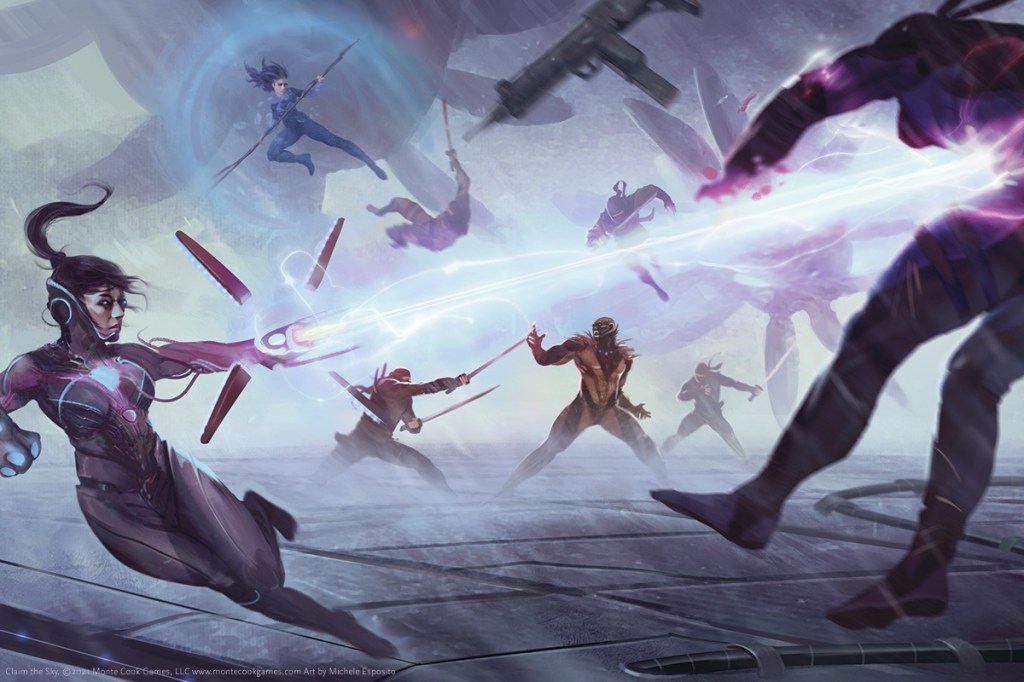
Combat
Cypher uses very familiar combat mechanics if you’ve ever played a game of pathfinder or 3.5 D&D. Characters can take only 1 action on their turn, which is most often: attack, use ability, move, wait, or something else.
Movement
Distances in cypher are broken up into categories: immediate (10 ft), short (50 ft), long (100 ft), and very long (150 ft+). If characters commit to a larger movement in their turn, they can move a short distance (50 ft). Characters can also take a quick little shuffle, moving an immediate distance (10 ft) as part of another action. If the character wants to add 50 feet of movement to their action (which could be movement), they must pass a difficulty level 4 speed task.
Attacking & Defending
When a player attacks, they use the relevant stat pool (str,spd,int) depending on what they’re attacking with. They then roll against the difficulty level provided by the GM. Typically, this is the difficulty level of the monster, but sometimes very large monsters are easy to hit, or small monsters are harder, which changes the difficulty level. Once the difficulty level and stat pool are set, the player adjusts the difficulty level as normal. Abilities, armor, or weapons can all adjust this up or down, as can the terrain or any effort spent by the player.
Defending is very similar. The primary difference is the GM typically tells the player which stat pool they’ll be rolling against. Defending against an axe is likely speed, while resisting poison is might, and resisting a psychic onslaught is intellect. Skills, assets, cyphers, can all adjust the difficulty of this roll.
Damage
If a player hits an enemy, or if an enemy hits a player, they do damage. Weapons do static damage of 2 for light, 4 for medium, and 6 for heavy. Characters and NPCs all have armor, which reduces incoming damage, 1 for light, 2 for medium, and 3 for heavy (fun fact: these aren’t in the core rulebook I own).
If the damage passes through an NPC’s armor, it deals damage to their hit points (HP). NPCs, unlike PCs, just have one big bag of HP, as opposed to pools. If damage passes through a PC’s armor, it typically subtracts first from the might pool, then the speed pool, and finally the intellect pool. When a PC’s pool is emptied, they fall 1 step down the ‘damage track:’
- No pools empty: hale, everything is great!.
- 1 pool empty: Impaired, applying effort takes 1 extra point per level. So that’s 4 points for 1 level of effort and 7 total points for 2 levels.
- 2 pools empty: Debilitated, you cannot take any actions other than to crawl an immediate distance (10 ft).
- 3 pools empty: Dead.
Recovery
Characters can only regain points by taking a ‘recovery,’ which gives them 1d6+tier points of healing. Characters have 4 recoveries: the first recovery takes an action, the second takes 10 minutes, the third is an hour and the fourth is 8 hours. After the 4th recovery (or 8 hours of just resting) they get them all back.
Example
Inara is in a desperate battle against a gun wielding terrorist, and she takes her first turn to move behind cover. The terrorist fires at Inara and the GM announces it’s a difficulty level 4 speed defense task to avoid getting shot. Inara is behind cover and trained in speed defense tasks, giving her an asset and a skill, reducing that by 2 levels. She then spends a level of effort, and with her speed edge of 2, that costs her only 1 point. That reduces this to a level 1 task, Mira rolls and gets a 2! She takes the damage, which the GM announces is 4 points. She has armor which reduces that by 1, but she takes 3 points to her might pool as the bullet hits her leather jacket.

When it’s Inara’s turn she attacks the terrorist, a difficulty 4 task. She’s trained in using guns, which reduces that by 1 step, and her weapon is a light weapon which acts as an asset for these tests. That’s 2 levels, so she spends 2 more levels of effort, costing her 3 points (5-2 for her speed edge). Mira rolls and gets a natural 20! That is a critical, meaning she can add 4 points of damage to the 2 her gun normally does. The terrorist has 2 armor so they take 4 damage.
Cyphers
How have we gotten this far without talking about cyphers, the namesake of the system? Well, honestly it’s because cyphers are a funny offshoot of the system. Cyphers are wildly simple on paper: they are small, one use items or abilities. PCs can hold a maximum number of these little guys, and if they exceed that something bad may happen. The book encourages GMs to hand them out like candy, giving players ample opportunity to use them. They are very often randomly generated, but sometimes a GM may select a few that are thematically appropriate for the situation.
As these are very often random, they are sometimes game breaking-ly useful and other times just a neat thing in the bag. There is an assumption baked into the system that the players will have a handful of these, as some of the higher level monsters are powerful and good cyphers can change a battle completely.
Closing
Whew! That’s everything for the Cypher system. It’s a surprisingly complex system that remains relatively light. The biggest hurdle is really just understanding how all the mechanics work (especially wrapping one’s head around effort, edge, and GM intrusions).
Resources
- Buy the books: [Cypher DTRPG, Numenera DTRPG, Monte Cook Games]
- Cypher Subreddit, Numenera Subreddit, Art of the ninth world Subreddit
- Online character builder [Cypher, Numenera]
- Cypher Unlimited Discord
 The Witch's Wandering Table
Leave a comment